
Start with the contents and picking task
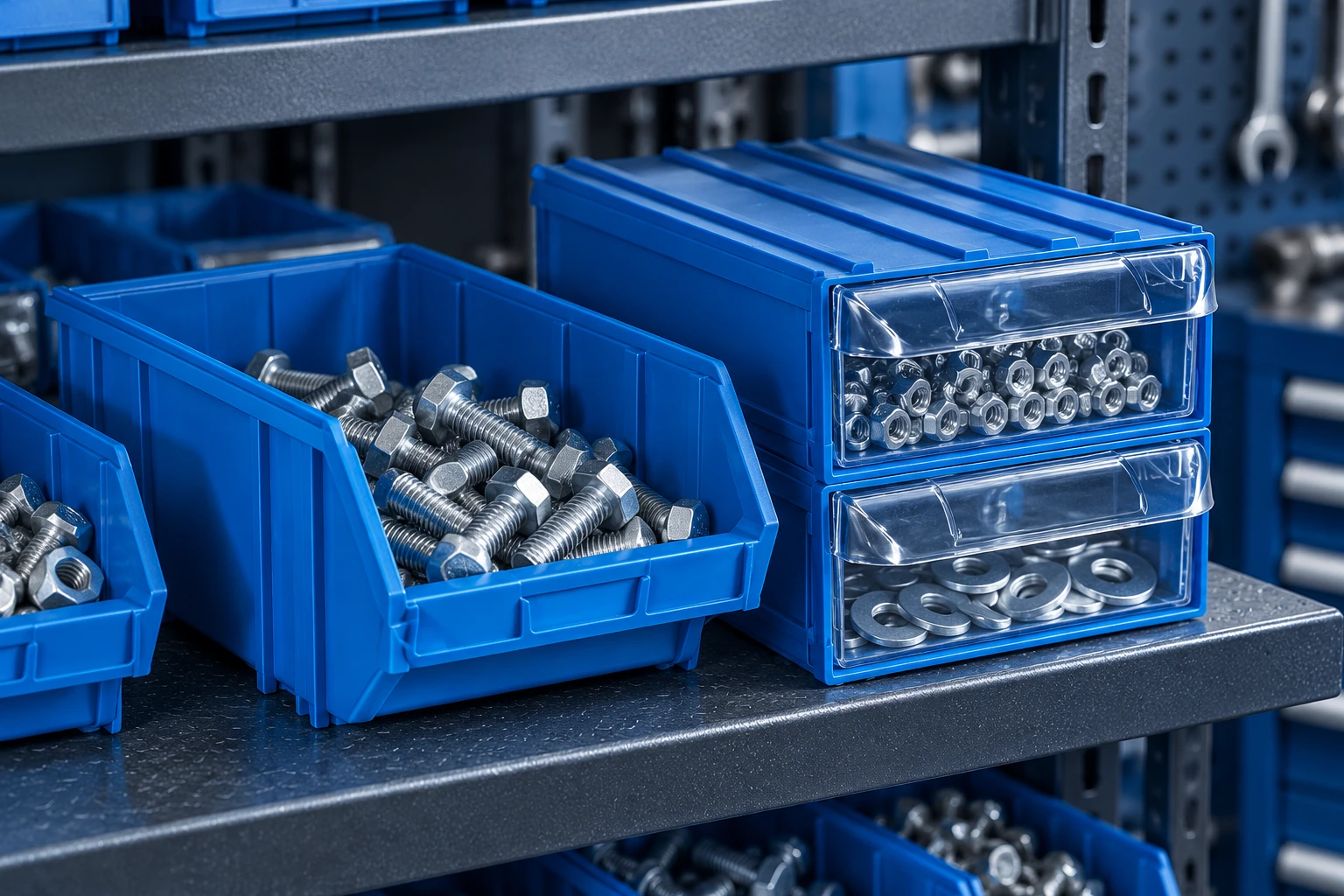
Plastic parts bins can help organise fasteners, small spares and assembly components, but begin with the contents rather than the colour. Check whether parts stored under one description are actually interchangeable. Differences in dimensions, material or part number should remain visible in the inventory instead of being hidden inside a general label.
Decide how many items belong at the point of use and how they are retrieved. A fastener picked individually and a component issued as a sealed package may need different arrangements. Set quantities around actual use rather than filling every available shelf. Testing a proposed bin with real components is more informative than judging it from a photograph.
Separate external size from useful access
External dimensions help plan shelf fit, while internal dimensions help establish whether the contents will fit. On an open-front bin, the picking opening matters too. BITO technical tables distinguish these measurements; look for the same distinction when assessing a product. A volume figure alone cannot show how easily a particular component can be removed.
An item may fit through the top but be awkward to retrieve from the normal working position. If gloves are used for the task, include them in the trial. Observe how long or irregular components settle inside the container. Check the proposed shelf arrangement with neighbouring bins in place, including label visibility and access to the lower row.
Treat labels as part of the system
A useful label may include the item name, part code and storage location. Decide which information deserves the most prominence based on the way users search. Use short, consistent descriptions rather than squeezing a long explanation into small text. Where components are easily confused, make the distinguishing information visible at the point of selection.
Colour can support identification, but avoid relying on colour alone. A new colleague or a different shift may not know an unexplained colour scheme. Keep location codes separate from item codes so that moving a part to another shelf does not change its identity. Where digital records are used, match the wording on the bin with the inventory record.
Define replenishment and upkeep
Agree when stock is checked, where empty containers go and who receives a replenishment request. Choose a review interval that reflects consumption. If you use a two-bin arrangement, set quantities using actual demand and replenishment time. Copying the same quantity across unrelated components can leave some items overstocked while others need constant attention.
Confirm stacking, loading, cleaning and special environmental requirements in the chosen product’s documentation. Do not assume that every plastic container provides the same chemical, temperature or electronic-component suitability. Establish how damaged containers and unreadable labels will be replaced. An orderly shelf needs current identification and stock information as well as a consistent physical arrangement.
Trial one shelf before scaling up
Run a small pilot at one shelf or workstation. Check how parts are loaded, picked, identified and replenished. Ask users which aspects are unclear or inconvenient, then adjust the plan. Expand the arrangement once the bin list and the replenishment routine reflect what you learned.
- Part codes, physical dimensions and required stock quantities.
- External dimensions, internal dimensions and picking opening.
- Shelf layout, visible labels and a realistic retrieval trial.
- Replenishment ownership, review intervals and record keeping.
- Model-specific loading, cleaning and operating information.
Frequently asked questions
Is bin volume enough to make a selection?
No. Consider the component shape, useful internal space, picking opening and shelf layout as well as volume.
Is every plastic bin suitable for sensitive electronics?
Do not assume this. Establish the application requirements and confirm that the selected product has the documented characteristics needed.