
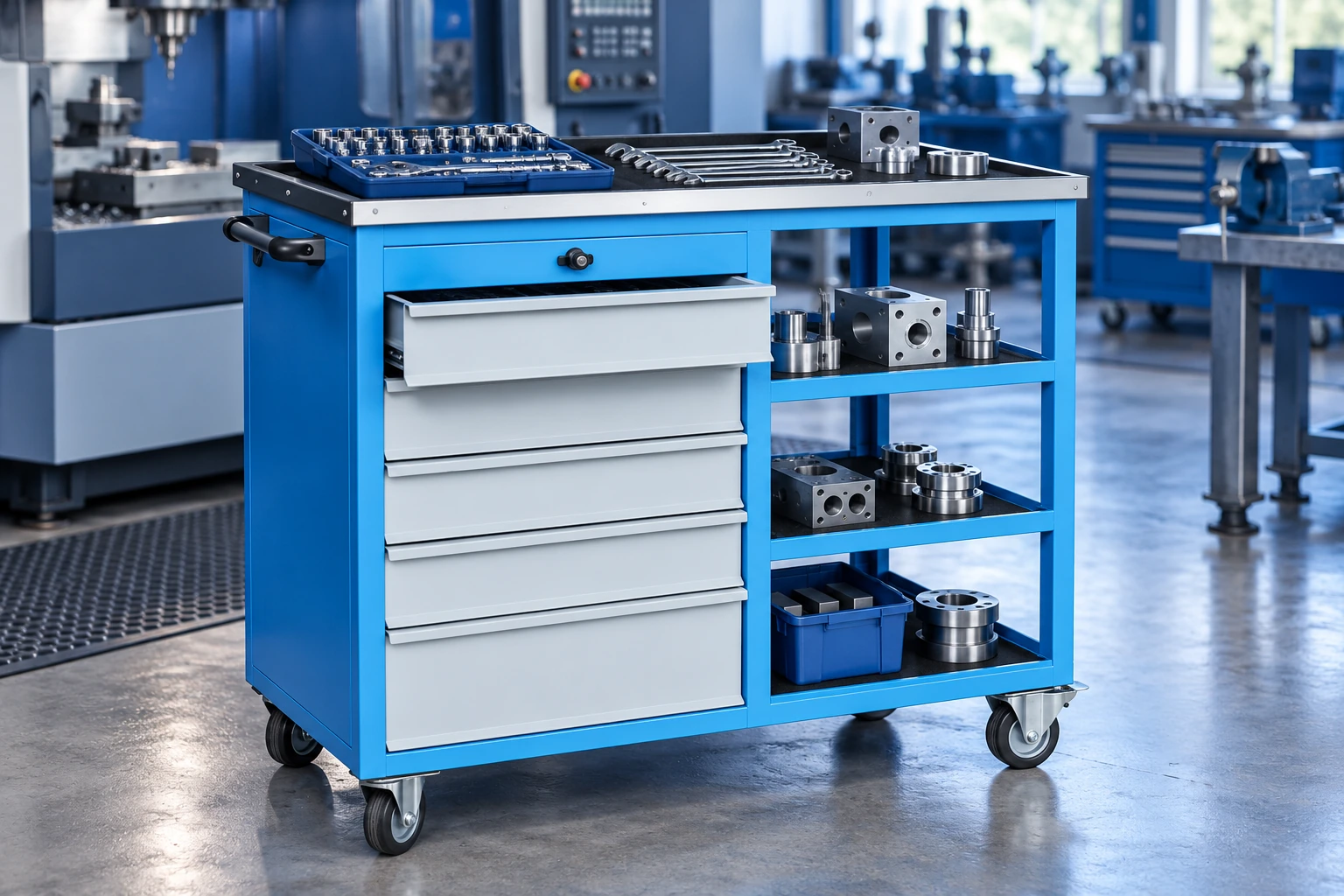
Define the trolley’s job
Before comparing tool trolleys, decide what the unit will do. Will it hold one technician’s permanent tool set, support maintenance around several machines, or move between assembly stations? These uses can lead to different layouts. A clear purpose makes it easier to judge whether a proposed configuration is useful rather than simply spacious.
Separate everyday tools from equipment used only for specialist jobs. Define the mobile kit instead of placing the entire workshop inventory on one trolley. Shared bulky equipment may deserve separate storage. Include missing tools and planned replacements in the inventory so that the drawer layout reflects the kit you intend to use.
Plan the contents before counting drawers
Lay out the tools and group them by activity. Long spanners, socket sets, measuring equipment and powered tools may need different spaces. Confirm usable internal dimensions rather than relying on the appearance of a drawer front. Inserts and organisers occupy space too, so include them in the proposed arrangement before choosing the cabinet.
Assign the contents of each drawer in advance. This avoids discovering after delivery that a long or tall tool has no suitable home. For shared equipment, a simple layout diagram and readable labels can help users return items consistently. Choose a system people can understand quickly, without needing to learn an unnecessarily elaborate classification scheme.
Walk the route and inspect the floor
Assess the trolley along its normal travel route, not only in its parking position. Record narrow turns, doorways, thresholds and the place where it will be stored. CCOHS guidance identifies floors, aisle space, travel distance and castor characteristics as relevant selection factors alongside the load. A capacity figure alone does not establish suitability.
Confirm wheel and brake options for the intended surroundings. If a representative demonstration is available, observe turning, stopping and access to the handle with a realistic load. Follow the selected product’s instructions for loading and movement. Establish how drawers are kept closed in transit and how the unit is secured while parked.
Make daily management part of the purchase
Give the trolley a parking location and a clear owner. Agree on a simple end-of-shift check and a way to distinguish a missing tool from one awaiting repair. When several people share the unit, involve them in the drawer layout. A system agreed by its users is easier to maintain than a plan imposed without seeing the work.
Review the arrangement after the first period of use. Notice which drawers become crowded and which tools are awkward to retrieve. Adjust the partitions and inventory in response. When the arrangement is ready to be repeated, retain the tool list and drawer plan so that similar stations can use the same understandable system.
Use a focused purchasing checklist
Describe the purpose and route when requesting a quotation. Confirm dimensions, capacities, locking arrangements and castor details for the actual model under consideration. The following checks help connect a product comparison with the way the trolley will be used every day.
- Actual tool inventory, including planned additions.
- Useful drawer dimensions and required inserts or partitions.
- Doorways, corners, floor condition and a dedicated parking place.
- Castors, brakes, locks and drawer retention arrangements.
- Operating instructions, maintenance requirements and documented load limits.
Frequently asked questions
When should a trolley replace a stationary cabinet?
A trolley is useful when tools need to follow the work. Shared or rarely used equipment may still be better organised in a separate stationary location.
Is the rated capacity enough to choose a trolley?
No. Internal dimensions, load arrangement, route, floor conditions and operating instructions also need to match the intended use.